 |
Exploring the Potential of Cooperative Robotics in Robot Art: The Art of Collaboration |
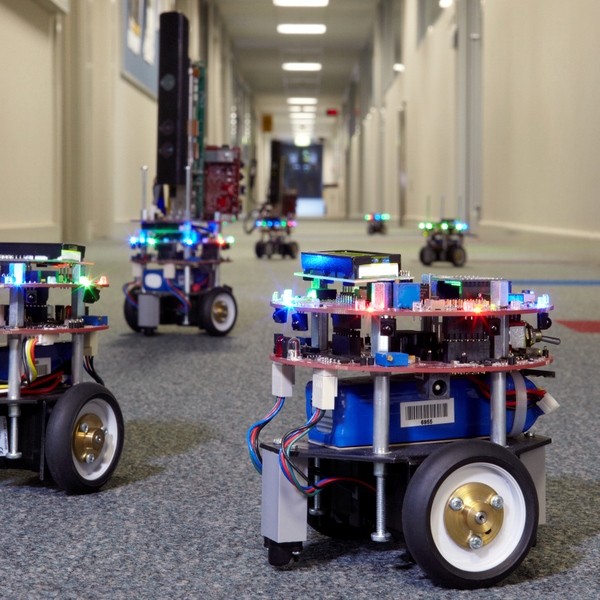
After a long hiatus, I have decided to revive my networked robotics projects. My long-term aim is to harness the power of cooperative robotics to explore the intersection of art and technology, with a focus on collaborative robot art. As a first step toward this goal, my friend and hardware design guru Ismet Atalar and I designed very low-cost differential-drive mobile robots (called SparkNodes) that can be easily tracked without expensive localisation hardware (the design is freely available, if you’re interested in building your own, everything you need is in the SyncSpark repository). Our plan is to build 30–40 of these and use them to experiment with well-known formation control techniques, demonstrating how complex emergent behaviour can arise from simple rules. A beautiful example is the Boids algorithm. For a real-world glimpse of this phenomenon, have a look at this fish swarm behaviour I recorded at the magnificent aquarium of the Oceanographic Museum of Monaco.

We will demonstrate these algorithms through a multi-robot light installation with my colleague Dr. Michael Burke, who is an expert on robotics, computer vision, and machine learning.
The project has since grown beyond art into research:
-
We are building a mobile robot network in collaboration with the Shortest Path Lab (SPL) at Monash University, led by A/Prof Daniel Harabor. SPL’s focus is AI planning and heuristic search for single- and multi-agent pathfinding problems such as trip planning in transportation networks or motion planning for mobile robots and automated warehouse logistics. Our robot network will serve as a practical testbed for moving some of these ideas from simulation into embodied, real-world experiments.
-
In a separate research collaboration, my colleague Dr. Timothy Molloy, who is an expert in distributed control and game theory applications, and I are working on multi-robot motion planning via dynamic games. The goal is to program a team of SparkNodes so that each robot moves to an assigned goal pose while avoiding collisions with the others. We plan to achieve this by modelling the problem as a linear-quadratic dynamic game, solved on a host computer that observes the full team state, computes coupled feedback commands for the whole swarm, and transmits synchronised motion commands to each robot.
One of the most rewarding aspects of research is seeing interesting ideas escape the laboratory: ChromaVertex is a community project that grew from my long-standing interest in cooperative robotics. Together with members of the Deep Dive Guild at Melbourne TechGuilds, we are building inexpensive VertexBots to explore swarm behaviour, computer vision, geometry, and distributed algorithms. The goal is not to compete with sophisticated research platforms, but simply to learn, experiment, and enjoy the journey together.
Through all of these efforts, I hope to advance the field of autonomous systems while creating captivating, dynamic collaborative artworks and, above all, having fun!